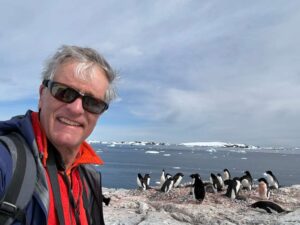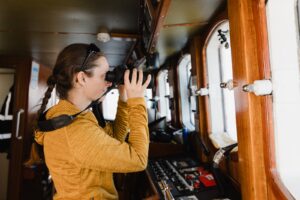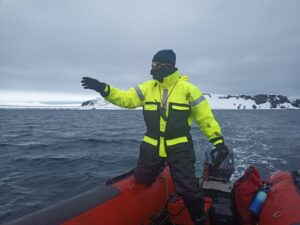
Next up in our crew spotlight is Martin Makarewicz , who goes by Mak, a Scientific Illustrator and Guide on the Hans Hanson and 60 South vessels.
About Mak
Mak has been drawing since before he can remember. Growing up, his mom would buy him a new book on biology each month from a collection of science books. Mak and his brothers would spend their weekends pouring over the images in each book, looking at drawings of animals and wildlife. One day, Mak’s mom came home with a videotape – an encyclopedia of the ocean. As Mak watched fish and whales, he felt as though he was discovering a whole new world within our planet. He recounts: “it wasn’t just photos and pictures for me. I think everything starts there.”
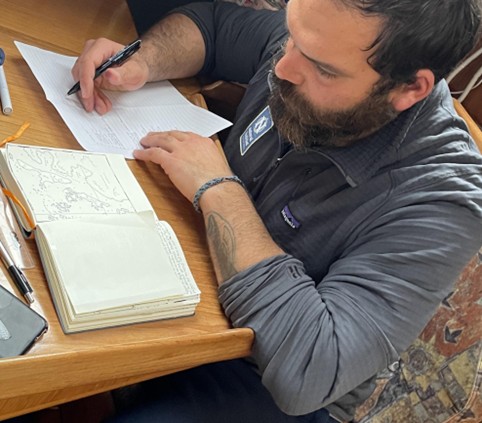
As he grew up, Mak continued drawing the plants and animals he saw around him. As his illustrations developed, he began to gravitate towards drawing more complex images from travel books and to write stories about new destinations. After putting together a portfolio of his art and sending it to different organizations, he began to work professionally as a scientific illustrator for research papers, museums, magazines, and books. Much of Mak’s time working is spent learning and researching about the topic he is drawing for so that his depictions can be as accurate as possible – this can cause one illustration to take up to 2-3 weeks.
One of Mak’s favorite parts of his job is getting to learn about new topics and see the world in a new way through his illustrations. One of the key reasons Mak is hired as an illustrator that – unlike a photograph – his drawings are easy to control. For example, if a scientist needs a depiction of a bird in a certain pose, it is easier to create a drawing than to spend the time trying to capture the perfect photo. Additionally, Mak is able to accentuate certain details of an image and simplify others, drawing the viewer’s eye to what the scientist aims to highlight. Mak recalls a particularly incredible moment in his job when he was hired to illustrate 50 fish on the coast of Peru, and noticed a certain characteristic that was shared amongst all the fish.
Work and Memories with 60 South
Before working with 60 South, Mak had traveled to Antarctica on a different ship, working as a cook, sailor, and guide. However, when offered a job with 60 South, Mak was eager to join the team because of the value the company places on preserving nature, requiring him to take exams on the rules of IAATO (International Association of Antarctic Tour Operators). Mak also describes the passengers on 60 South trips as being incredibly curious, showing interest in citizen science projects such as the photoidentification of marine mammals. His favorite moment on a trip is when a passenger who may live far away from nature will finally make it to the Antarctic and ask him “what can we do to take care of this?”
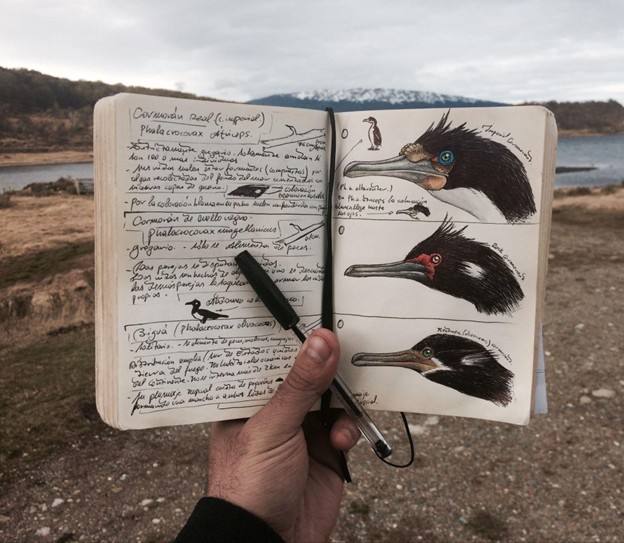
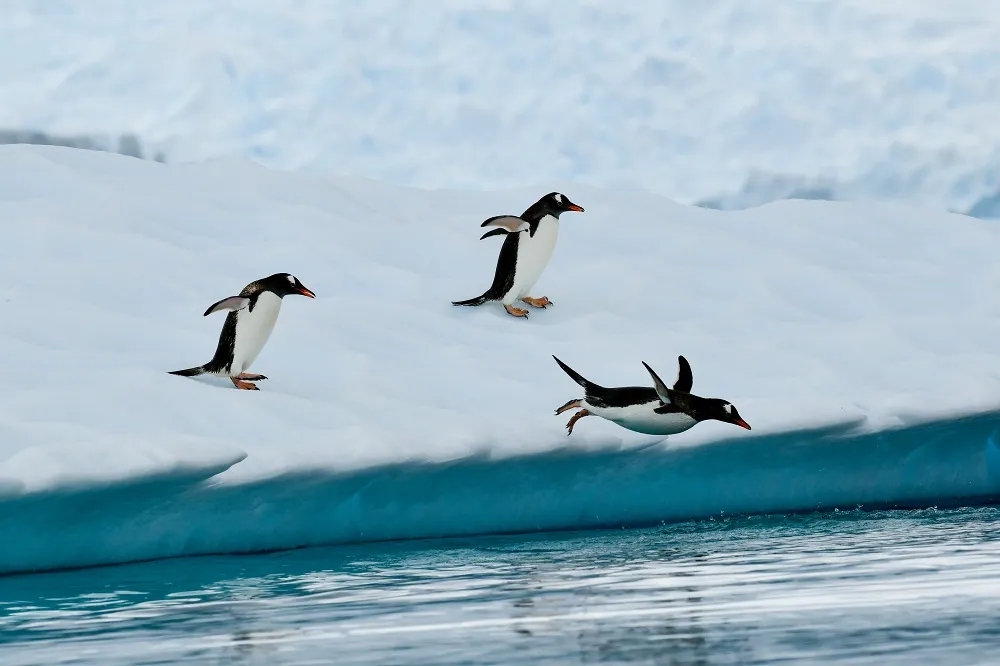
When working on a trip, Mak always ensures he wakes up early. Every morning, he loves talking to passengers about their experiences. He particularly enjoys seeing the unique perspective of photographers, getting to look at each person’s different point of view when observing a landscape or animal. On days when the ship is not able to complete its intended landings due to weather, Mak enjoys giving presentations on different animals such as penguins, and playing bingo.
Personal Projects and Interests
In addition to working as an illustrator and guide, Mak partook in a number of citizen science and marine conservation projects. One project Mak was involved in was on a floating lab in Spain, where they filtered different parts of the Mediterranean Sea to observe the microplastics in the water, and hosted workshops for adults and children on environmental conservation. Mak has also dedicated a lot of time to sea turtle conservation. He has spent six years backpacking through different countries in Latin America and trying to volunteer with every turtle conservation camp or organization. Through this he has now created a database of all of the activities each organization does to volunteer.

Mak also enjoys writing and illustrating in his travel journals, filling them with memories and maps of the places he has been. Oftentimes, people will approach Mak and tell him they wish they could draw like him. However, Mak’s humble response is that “it is not a superpower, it is just practice,” stating “I think anyone can do this. Anyone can do my job.” He implores others to start a travel journal of their own, even if they don’t believe they can draw well or write poetically. All it takes is a notebook to start.