
By Alex Gayer
While interning with 60 South this January, I had the incredible opportunity to interview crew members and scientists involved in their Antarctic expeditions. Hearing their stories and discovering shared interests along the way was one of the most rewarding parts of my internship. Here’s a sneak peek at some of the stories and insights that didn’t make it into my other blog posts.
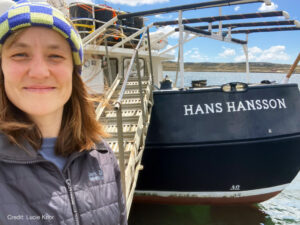
Gonzalo, the first mate aboard the Hans Hansson, is an avid whitewater and sea kayaker. When I mentioned that I spent last summer sea kayaking along the coast of my home state, North Carolina, I was impressed to learn that Gonzalo once sailed down the ocean side of the state’s barrier islands during a tropical depression while traveling from Boston to Florida. Known as the Graveyard of the Atlantic, this coastline is infamous for its strong Gulf Stream currents, unpredictable weather, shallow shoals, and powerful waves. Gonzalo ultimately arrived in South Carolina with a broken sail and rudder, a testament to his experience sailing in challenging conditions.
I also spoke with Becky, a stewardess on the Hans Hansson who leads 60 South’s citizen science program. Outside of Antarctica, she is interested in sustainable agriculture, a passion we share. Becky emphasized how accessible citizen science can be, sometimes as simple as snapping a photo of the clouds from the ship to help scientists verify satellite imagery. These small contributions are especially valuable in Antarctica, where funding and logistics often limit how frequently researchers can collect data themselves.
As an Ecology and Evolutionary Biology major with a strong interest in marine conservation, I was inspired to learn about the many ways people contribute to science beyond traditional academic pathways. Maria Laura, 60 South’s Bookings and Travel Assistant, is also a professional diver and underwater photographer who collaborates with scientists to communicate conservation issues through her art. Her work has contributed to important conservation and management outcomes, including the protection of Península Mitre in southern Argentina, a biodiversity hotspot.
I also had the opportunity to speak with Dr. Julie Mestre about her fin whale research. Her work is part of a larger project focused on protecting Antarctic krill stocks, which form the foundation of the Southern Ocean food web. Dr. Mestre highlighted the realities of research in Antarctica, including rapidly changing weather, the need for flexibility, and the importance of backup plans. At the same time, she noted that fieldwork often leads to new research questions, which is one of the things that makes science so exciting.
A theme that stood out throughout these conversations was the deep interconnectedness of the Antarctic ecosystem. Whales migrate long distances to feed on krill in Antarctica and breed along distant, warmer coastlines, so changes in krill populations caused by climate change or commercial fishing can have far-reaching effects throughout the marine ecosystem. For example, research has shown that in years with fewer krill, humpback whale pregnancy rates decline. Whales also help recycle nutrients in the ocean, which supports the growth of phytoplankton, the main food source for krill, creating feedbacks that benefit multiple species. Protecting both krill and whales through precautionary management measures on krill fisheries is therefore essential, as the health of each species influences the stability of the wider Antarctic ecosystem.
As my internship comes to an end, I feel grateful for the connections and insights I gained. Learning from the people who work in Antarctica reinforced the importance of collaboration, adaptability, and curiosity in protecting one of the most pristine places on Earth. After hearing about their experiences, I hope more than ever to one day visit myself!